
Fracture Care for Acute Foot Injuries
Evidence-based surgical repair of foot and ankle fractures from experienced surgeons focused on getting you back on your feet.

What You Need to Know
Learn how our surgeons approach foot and ankle fracture repair.
Foot and Ankle Fracture Repair
The surgeons at Integrative Foot and Ankle Centers of Washington have extensive experience in surgical repair of foot and ankle fractures and take an evidence-based approach in surgical treatment. Whether the injury involves a single toe or a complex break through the ankle joint, the goal is always to restore alignment, stability, and function.
In 1958 the Swiss founded Arbeitsgemeinschaft für Osteosynthesefragen, German for “Association for the Study of Internal Fixation,” commonly referred to as AO. This association is responsible for the principles of fracture management followed by our surgeons today. These principles include achieving anatomic reduction of the fractures, utilizing stabile fixation, using an atraumatic technique, and beginning early mobilization as soon as possible after surgery.
We treat the following fractures and dislocations:
Digital fractures, metatarsal fractures, sesamoid fractures, Jones fractures, Lisfranc fracture dislocations, cuboid and cuneiform fractures, navicular fractures, navicular stress fractures, talar fractures, calcaneal fractures, and ankle fractures.
If you have sustained an acute foot or ankle injury, or suspect a bone may be broken, prompt evaluation is important. Our surgeons will review your injury and discuss the treatment options best suited to your specific fracture pattern.
Our Surgical Approach to Fractures
General surgery for a fracture includes realigning the broken bones and placing hardware such as plates and screws across the fracture to stabilize the bones until they are healed. The specific procedure and duration of recovery largely depend upon the injury sustained, the location of the fracture, and the demands the patient places on the foot and ankle.
Before surgery is recommended, each fracture is carefully evaluated to determine whether surgical fixation will produce the best long-term outcome. Some fractures may be managed without surgery, while others, particularly those that are displaced, unstable, or involve a joint surface, benefit from operative repair to restore proper anatomy.
During surgery, our team follows the AO principles of anatomic reduction and stabile fixation, using techniques designed to protect the surrounding soft tissue. This atraumatic approach helps support healing of both bone and the tissues around it.
Early mobilization is another core principle. Beginning appropriate movement as soon as possible after surgery helps reduce stiffness, protect joint function, and support a return to daily activities. Recovery timelines vary by fracture type, and your surgeon will guide you through each stage of healing and rehabilitation.
Locations Offering Fracture Care
Find a nearby office for evaluation and treatment of your foot or ankle fracture.

Integrative Foot and Ankle Centers of Washington, Port Orchard
1950 Pottery Avenue, Suite 120
View Clinic

Integrative Foot and Ankle Centers of Washington, Bremerton
900 Sheridan Road, Suite 101
View Clinic
Integrative Foot and Ankle Centers of Washington, Renton
4300 Talbot Road South, Suite 315
View Clinic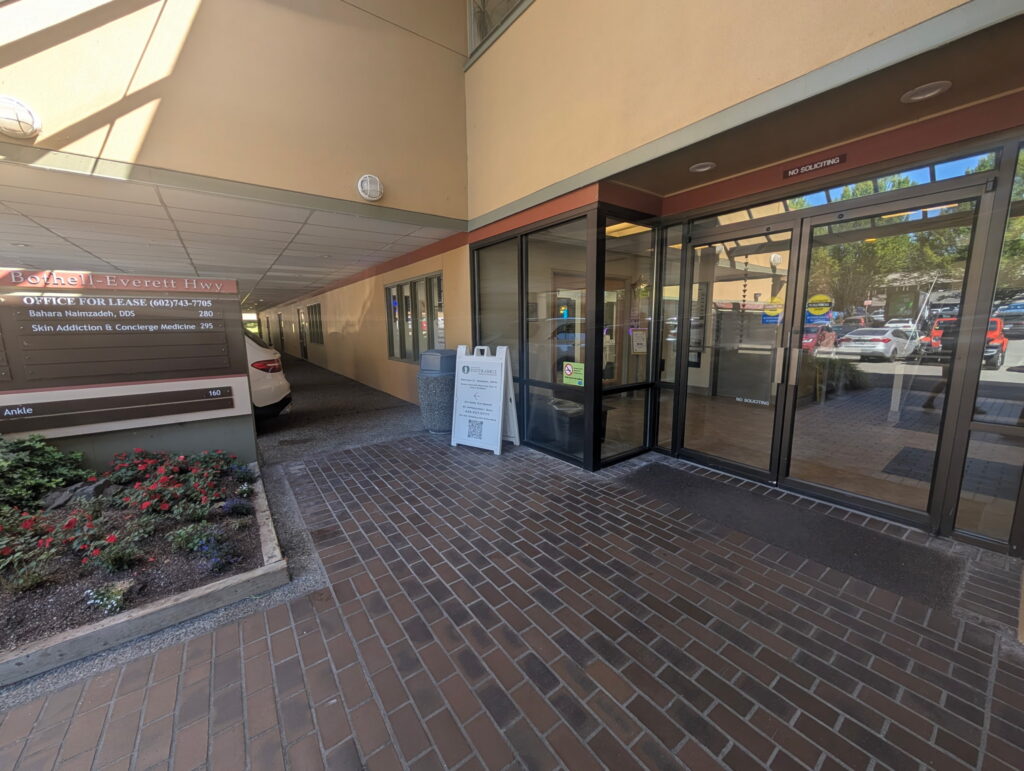
Integrative Foot and Ankle Centers of Washington, Mill Creek
16030 Bothell Everett Highway, Suite 160
View Clinic
Integrative Foot and Ankle Centers of Washington, Kirkland
13030 121st Way NE, Suite 204
View Clinic
If you think you’ve broken a bone in your foot or ankle, don’t wait to get it checked.
Our surgeons are here to help you heal properly and get back on your feet.